
Crane vs Boom Truck for HVAC Lifting
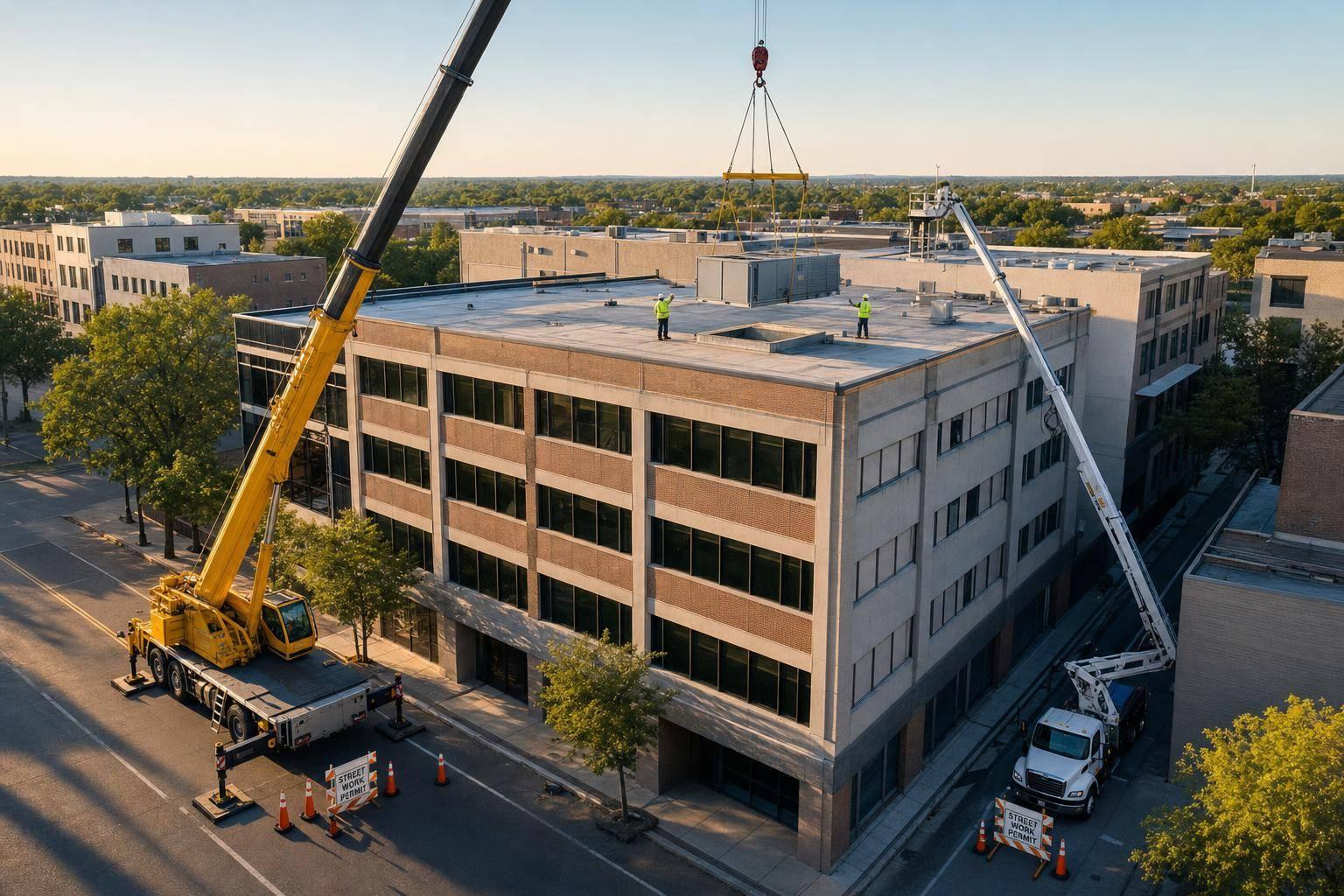
If your HVAC unit is heavy, high, or far from the roof edge, I’d lean toward a crane. If it’s a low-rise swap with short reach, a boom truck may be enough.
Here’s the short version: for most rooftop HVAC lifts, the choice comes down to 4 things:
- Unit weight
- Roof height
- Working radius
- Site access
I’d also keep this in mind: rooftop HVAC units often weigh 800 to 8,000+ lb, and many placements happen 30 to 80 feet up. That means the machine that looks fine on paper can still fail the lift once reach and clearance are added in.
What I take from this comparison:
- Boom trucks fit many low-rise RTU swaps near the roof edge
- Cranes make more sense when the load is heavier, the building is taller, or the unit sits farther back
- Capacity drops hard with distance, so the load chart at the actual radius matters more than the truck’s headline rating
- In places like Long Island, New Jersey, and NYC, street space, permits, traffic control, and power-line clearance can decide the job before lifting starts
- The lowest day rate does not always mean the lower total job cost
Quick Comparison
| Factor | Boom Truck | Mobile / Hydraulic Crane |
|---|---|---|
| Best use | Low-rise HVAC lifts | Heavier or longer-reach lifts |
| Typical building type | 1–2 stories, sometimes mid-rise | Mid-rise to high-rise |
| Radius tolerance | Works best with short setback | Better for deep setback |
| Setup | Less site prep | More room, more planning |
| Access | Better for tighter sites | Harder on narrow streets |
| Cost | Lower starting cost | Higher starting cost |
| Permits | Often simpler | Often more permits and coordination |
So if you’re choosing between the two, I’d start with one question: where will the machine sit, and what does the load chart say from that exact spot? That answer usually tells you more than the unit weight alone.
Rooftop Crane Lifts Done Right | Commercial HVAC Basics
sbb-itb-798c36f
Boom Trucks for HVAC Lifting: Strengths and Limits
A boom truck is a hydraulic lifting unit mounted on a truck chassis. For low-rise HVAC lifts with short reach, it can be a fast, no-fuss option. But the same three things still call the shots: weight, reach, and site access.
Where a Boom Truck Works Well
Boom trucks are a good match for low-rise commercial buildings. Picture a one- or two-story strip mall, a small office building, or a retail site where the rooftop unit sits close to the roof edge. If the truck can park at the curb or in a parking lot, and the unit doesn’t need to move far across the roofline, the lift is often pretty simple.
They also make sense for fast equipment swaps. If a packaged rooftop unit fails and the replacement has to go in fast, a boom truck can often get to the site with less delay.
Some boom trucks can haul the unit and make the lift with one vehicle. That can save time and simplify the job. But that edge tends to fade once the lift gets taller or the reach gets longer.
Where a Boom Truck Falls Short
The big constraint is capacity loss at longer reach. A 17-ton boom truck may lift 34,000 lb near the bumper, but only about 650 lb at an 80-foot reach. That’s a huge drop.
Once a building moves past the one- or two-story range, or the HVAC unit has to clear a parapet, rooftop curb, or other rooftop equipment, the working radius increases and the truck’s usable lifting power drops. Then site issues start piling on. Overhead utility lines, soft ground in the setup area, or a narrow street that forces the truck to sit farther from the building can turn a simple lift into a tight one. At that point, any cost edge can disappear fast.
The key point is simple: load chart, reach, and rooftop clearance decide the lift - not unit weight alone. If reach, height, or rooftop clearance pushes the truck close to its limit, a crane is usually the better choice.
Mobile and Hydraulic Truck Cranes for HVAC Lifting: Strengths and Limits
Crane lifts handle the jobs boom trucks simply can't. But that extra muscle comes with a catch: more planning, more setup, and more coordination on site. When a boom truck hits its limit because of weight, height, or reach, a mobile or hydraulic truck crane is usually the better fit. These cranes are often used for large packaged rooftop units, chillers, and cooling towers on mid- and high-rise buildings.
When a Crane Is the Right Choice
The decision usually comes down to three things: weight, height, and radius.
Once an HVAC unit goes past roughly 8,000-10,000 lb, sits on a building taller than 4-6 stories, or needs a boom radius beyond about 120-150 ft, a mobile crane is often the safer and more practical pick. At that point, it’s not just about whether the crane can make the lift. It also needs enough capacity to keep a safe margin at that working radius.
That same rule applies when the lift gets tricky in other ways. Maybe the unit has to clear a penthouse. Maybe it has to slip between nearby buildings. Maybe it needs to land on a tight steel dunnage frame with very little room for error. In those cases, precise boom control matters just as much as lifting strength.
Mobile cranes range from about 30 to 825 tons, and many HVAC lifts fall into the 90-ton-plus range. They can also move between multiple buildings in one day, which helps on multi-site HVAC jobs.
Planning Requirements for Crane Lifts
That extra lifting power brings heavier logistics.
Mobile cranes need more room for outriggers, mats or cribbing, and counterweights. In dense Northeast cities, a crane lift may also mean street permits, agency notices, police coordination, and traffic control. Approval lead times can stretch from a few days to several weeks. And to cut down on disruption, some lifts get pushed to weekend or overnight windows, which can affect labor scheduling and building operations.
A solid pre-lift process isn't optional. It usually includes:
- A site survey
- Accurate gross load calculations
- A load chart review based on the crane’s actual position and radius
For lifts over occupied spaces or above certain weight limits, the lift plan may also need to be treated as a critical lift. That’s a big part of what separates crane lifts from boom truck lifts in day-to-day work. For HVAC projects, the extra setup is the cost of getting the reach and capacity the job calls for.
Crane vs Boom Truck: Side-by-Side Comparison for HVAC Projects
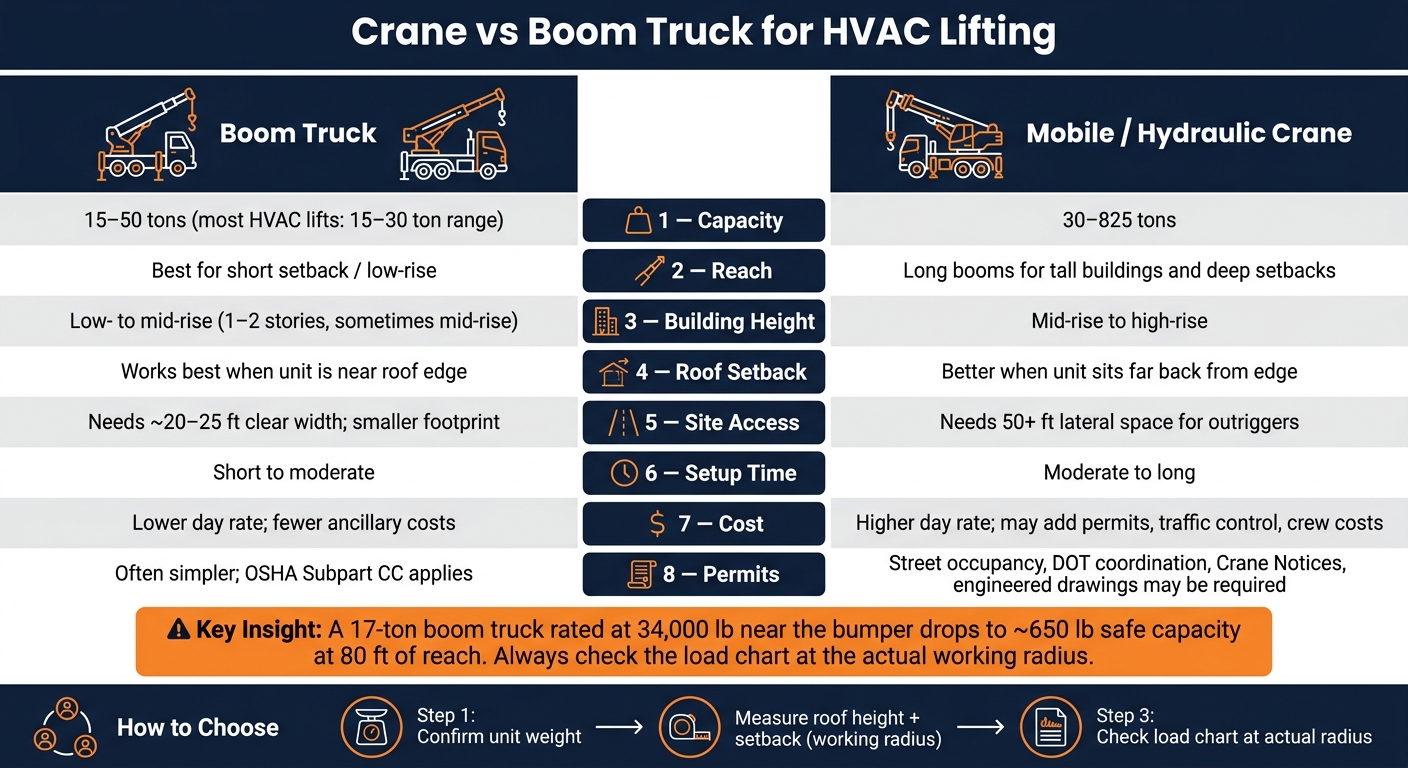
Crane vs Boom Truck for HVAC Lifting: Side-by-Side Comparison
Technical Factors That Drive Equipment Selection
With the basics out of the way, this choice usually comes down to the lift chart and the site layout. In practice, three numbers drive the call: unit weight, roof height, and roof setback. Roof setback determines the working radius, and working radius determines capacity.
That point matters more than a lot of crews expect. Boom-truck capacity falls off fast as radius grows. A 17-ton boom truck may handle 34,000 lb at a very short radius, but at about 80 ft of reach its safe capacity can drop to roughly 650 lb. So tonnage by itself doesn't tell you much. You have to check the lift chart at the actual working radius for that job.
Many 15- to 30-ton boom trucks can handle low-rise RTU swaps when they can park close and the unit is near the roof edge. Once the unit gets heavier, the building gets taller, or the setback pushes the radius farther out, the job often calls for a 40- to 100-ton hydraulic truck or all-terrain crane.
The side-by-side view below turns those jobsite limits into a simpler decision.
| Factor | Boom Truck | Mobile / Hydraulic Crane |
|---|---|---|
| Capacity | Commonly 15–50 tons; many HVAC lifts fit the 15–30-ton range | About 30–825 tons |
| Reach | Good for many low-rise, short-setback HVAC lifts | Longer booms for tall buildings and deep setbacks |
| Building Height | Low- to mid-rise | Mid-rise to high-rise |
| Roof Setback | Works best when the unit is near the roof edge | Better when the unit sits far back from the edge |
| Site Access | Street-legal, smaller footprint, easier in tight spots | Needs more room for outriggers, counterweights, and staging |
| Setup Time | Short to moderate | Moderate to long |
| Cost Range (USD) | Lower day rate; fewer ancillary costs | Higher day rate; may add permits, traffic control, and crew costs |
| Lift-plan complexity | OSHA Subpart CC applies; planning is usually simpler. | More frequent formal lift plans and critical lift plan review |
Cost, Schedule, and Compliance Tradeoffs
Once capacity is settled, cost and schedule usually make the final call.
Boom trucks usually cost less per day and can get in and out faster. On a run of low-rise RTU swaps, that speed can cut labor hours in a big way. But here's where jobs can turn on you: if a boom truck has to reposition more than once, or if the load is sitting near the limit of the chart at the needed radius, the extra time and added risk can wipe out those day-rate savings fast.
Larger cranes come with higher day rates, especially in dense markets like New York, where mobilization, permits, and traffic control can push up the front-end cost. Still, for one well-planned lift on a taller building, a single crane mobilization may cost less than several borderline boom truck tries. That's why the smart way to price the job is total cost per completed lift - not day rate alone.
Power-line clearance can also shape where the machine can park and which piece of equipment can even work on the site. Across Long Island, the five boroughs, and New Jersey, that clearance can require about 20 ft of separation from energized lines rated up to 350 kV. That affects boom swing direction and can sometimes rule out one equipment type altogether.
Next, these same limits get even tighter on Northeast jobsites with restricted access and permit pressure.
Northeast Jobsite Conditions and Final Recommendations
Why Site Access and Permits Affect Equipment Choice
When lift capacity is close, site access in the Northeast often makes the call. A boom truck usually needs about 20 to 25 feet of clear width. A 60-ton mobile crane may need more than 50 feet of lateral space for its outrigger spread.
In the five boroughs, crane mobilization and operation can trigger a long list of approvals: street occupancy permits, DOT coordination, Crane Notices, and Transit Authority approvals. In dense urban areas, that process gets tighter. Depending on the site and the size of the building, NYC may also require engineered drawings as part of the permit process.
And here’s where jobs can shift fast. Even a lighter unit may still call for a larger crane if setbacks increase the radius. On tight Northeast rooftops, those urban setbacks often push a project into crane territory before unit weight becomes the main issue.
Key Points for HVAC Lift Planning
Before you pick equipment, confirm four things:
- Load
- Radius
- Access path
- Permit path
That’s the starting point. After the unit is set, the job may not be over. A rigging crew might still need to roll or move the equipment across the rooftop, and that part of the work calls for certified personnel such as Master Riggers, Certified Signalmen, Certified Flaggers, and Pedestrian Managers.
L&M Crane supports HVAC lifting across Long Island, the five boroughs, the greater New York area, and New Jersey with boom trucks, cranes, and rigging services. In Northeast HVAC work, the right machine is the one that fits the load, radius, and site.
FAQs
How do I calculate the actual lift radius?
Measure the horizontal distance from the center of the crane’s rotation to the center of the load in its final placement position.
Include this measurement in your pre-lift plan and on your site drawings, along with boom length, load position, and clearance distances. Accuracy matters here. It affects both safety and crane selection.
L&M Crane recommends checking site-specific requirements with a crane specialist or engineer before the lift.
When does a boom truck stop being cost-effective?
A boom truck stops making financial sense when the lift goes past its capacity, which is usually around 54 tons. It’s a solid fit for lighter jobs in urban areas. But once lifts get heavier or more involved, the work can take longer, and total project costs can climb.
It can also be a weaker choice on rough or uneven ground. In those cases, an all-terrain crane may deliver better long-term value, even if its hourly rate is higher.
What permits are usually needed for an HVAC crane lift?
HVAC crane lifts often need permits. And those permits usually depend on engineered drawings that show crane placement, load details, and site clearances.
Depending on the job location and the size of the building, you may also need:
- Crane notices
- Transit authority approvals
- Traffic or parking documentation
Rules can change from one municipality to the next. Site conditions can also shift what paperwork is required. That’s where L&M Crane can step in. The team can handle permits, engineering documentation, and regulatory filings to help keep your project compliant and on schedule.
Related Blog Posts
Related Articles
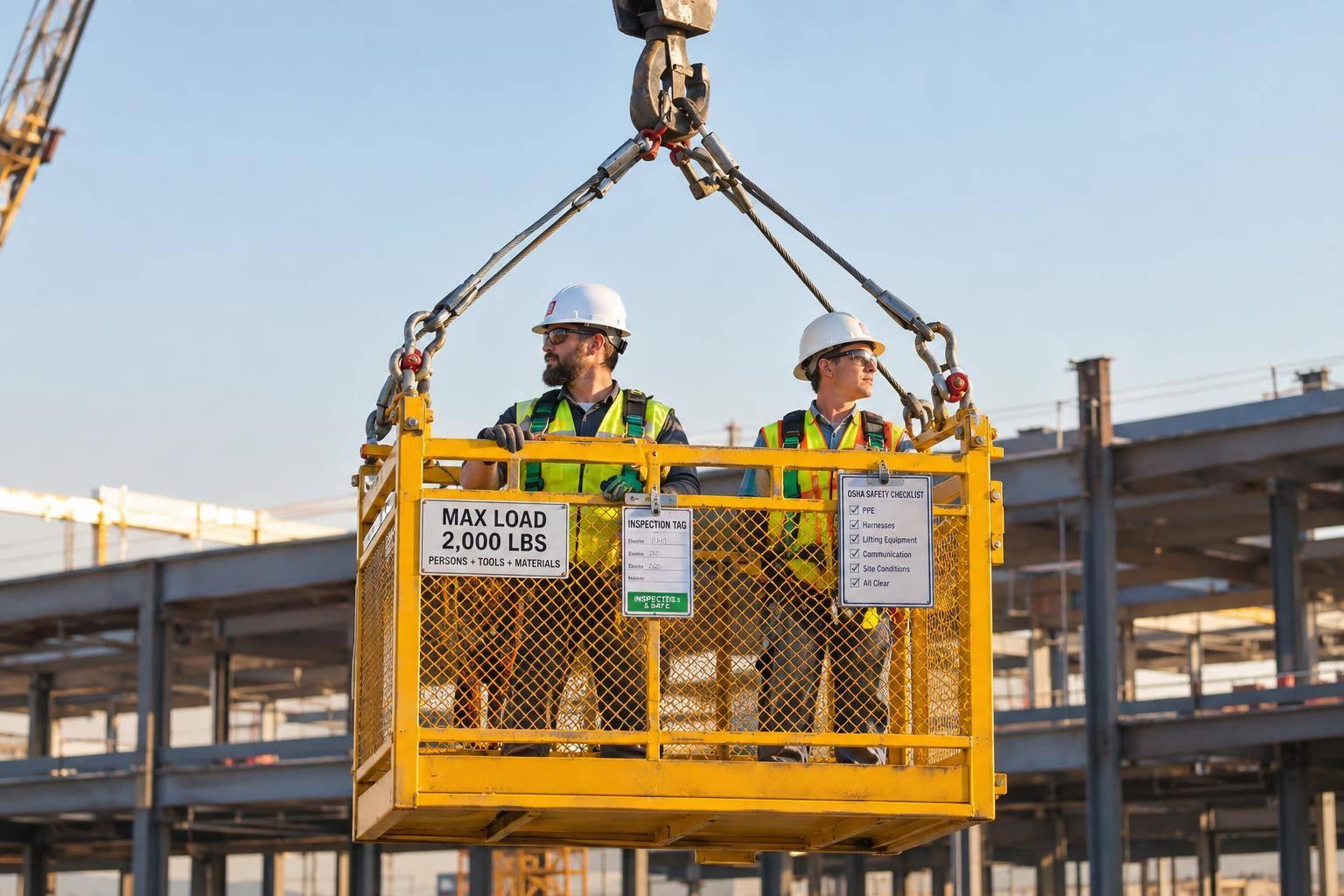
Man Basket Safety Standards: OSHA Guidelines
OSHA checklist for crane-hoisted man baskets: design, proof tests, trial lifts, fall protection, training, and rescue plans.
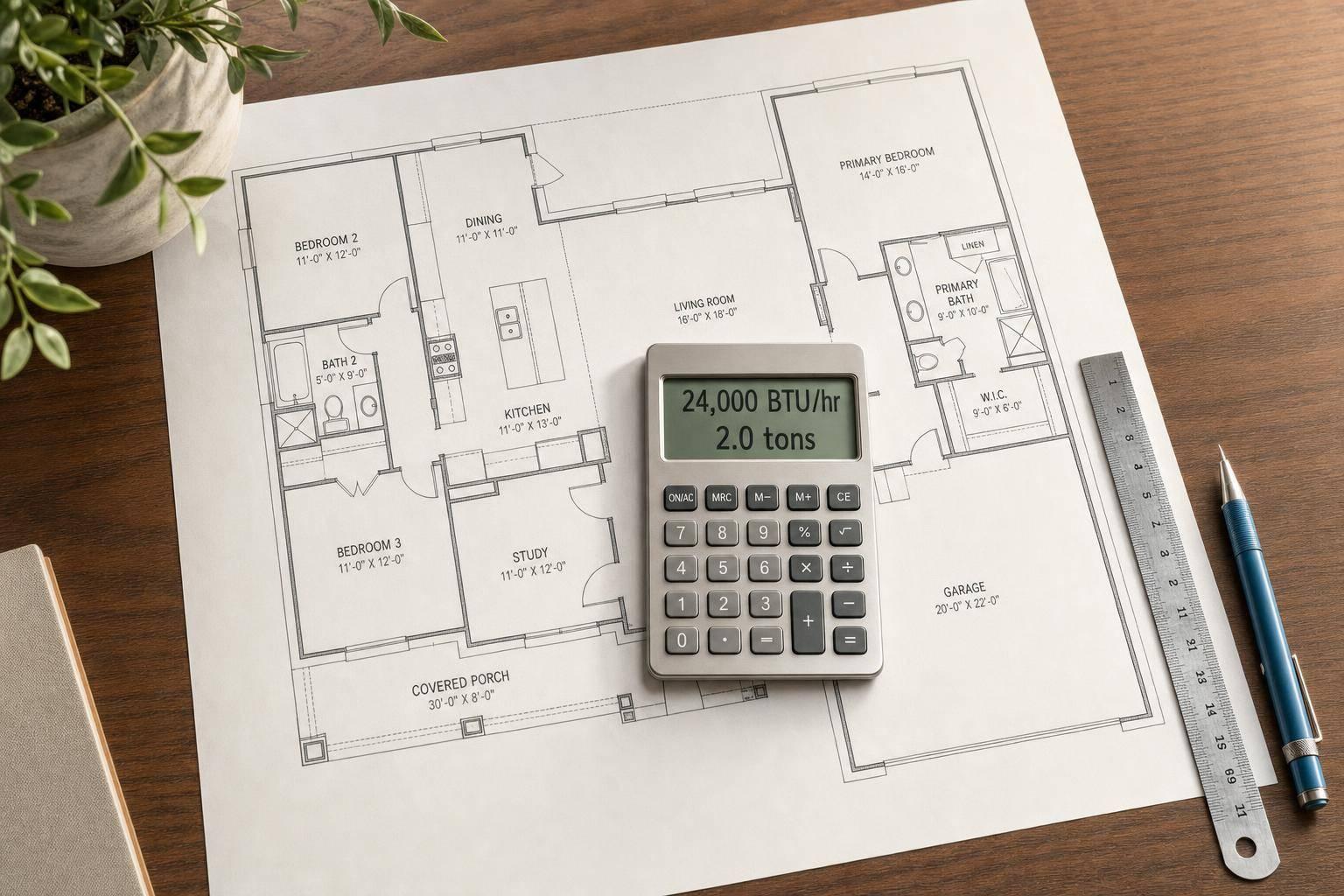
HVAC Tonnage Calculator
Estimate AC size in BTU/hr and tons using area, climate, insulation, and more—then compare your result with practical unit size ranges.

Rigging Inspection Checklist
Run a fast pre-use rigging inspection, flag unsafe conditions, and get a clear pass or Do Not Use result for the jobsite.