
Man Basket Safety Standards: OSHA Guidelines
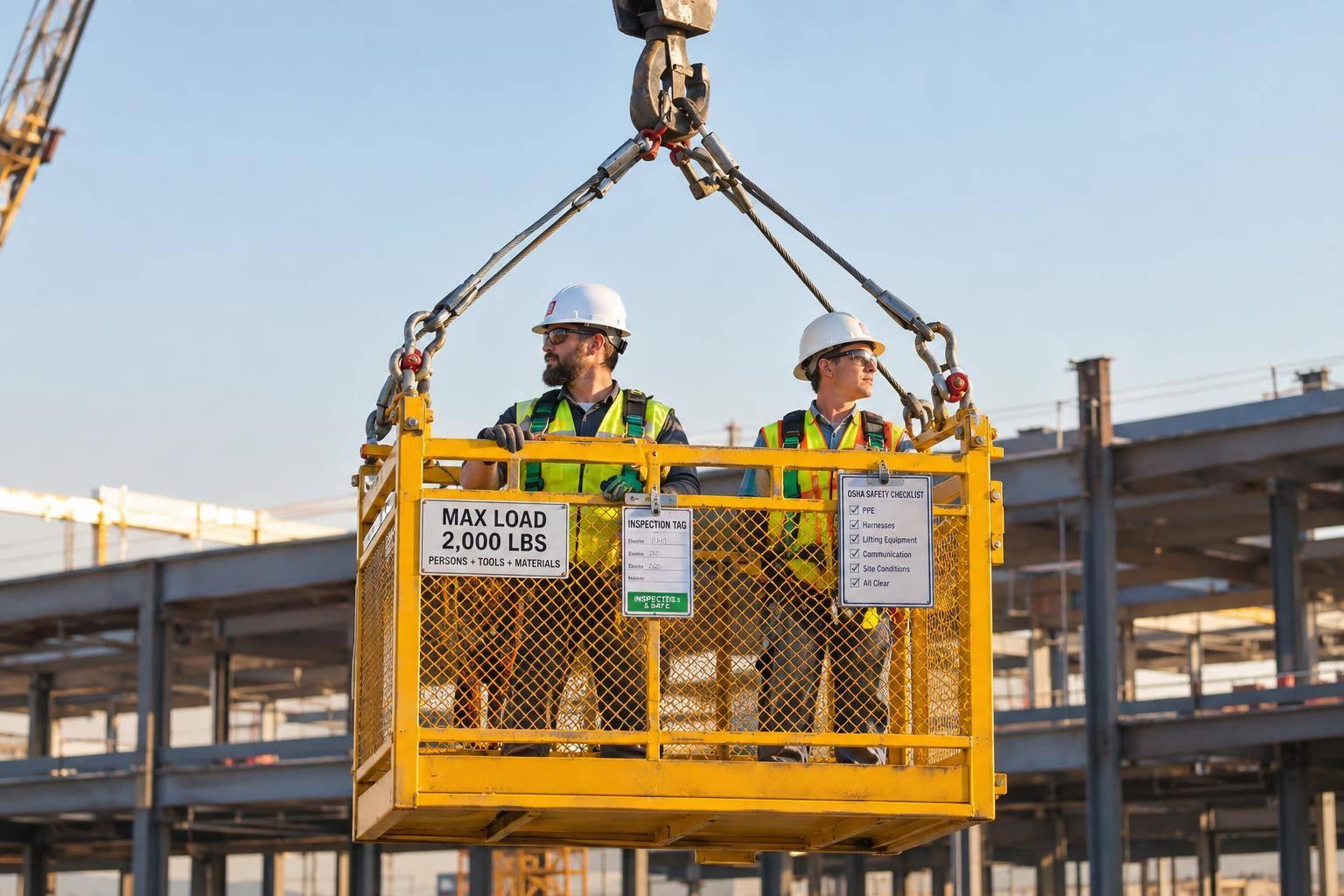
We use crane-hoisted man baskets only when other access methods would be more hazardous or impractical because of site or structural conditions - not to save time or money. For construction work, OSHA generally limits the total personnel-hoisting load to 50% of the crane’s rated capacity in its actual setup.
Before anyone boards, we check:
- Equipment and capacity: The correct OSHA standard, platform design, rigging, ground support, and manufacturer limits.
- Tests and inspections: A proof test at 125% of platform capacity, the required trial lift, and an occupied-platform stability check.
- Worker protection: Fall protection, secured tools, power-line clearance, weather, and clear communication.
- Crew readiness: Training, worker qualifications, a pre-lift meeting, rescue arrangements, and required records.
Hiring a crane provider does not transfer our safety duties. <u>We confirm every required check before the lift</u>, including state rules and any local permit or New York City basket requirements.
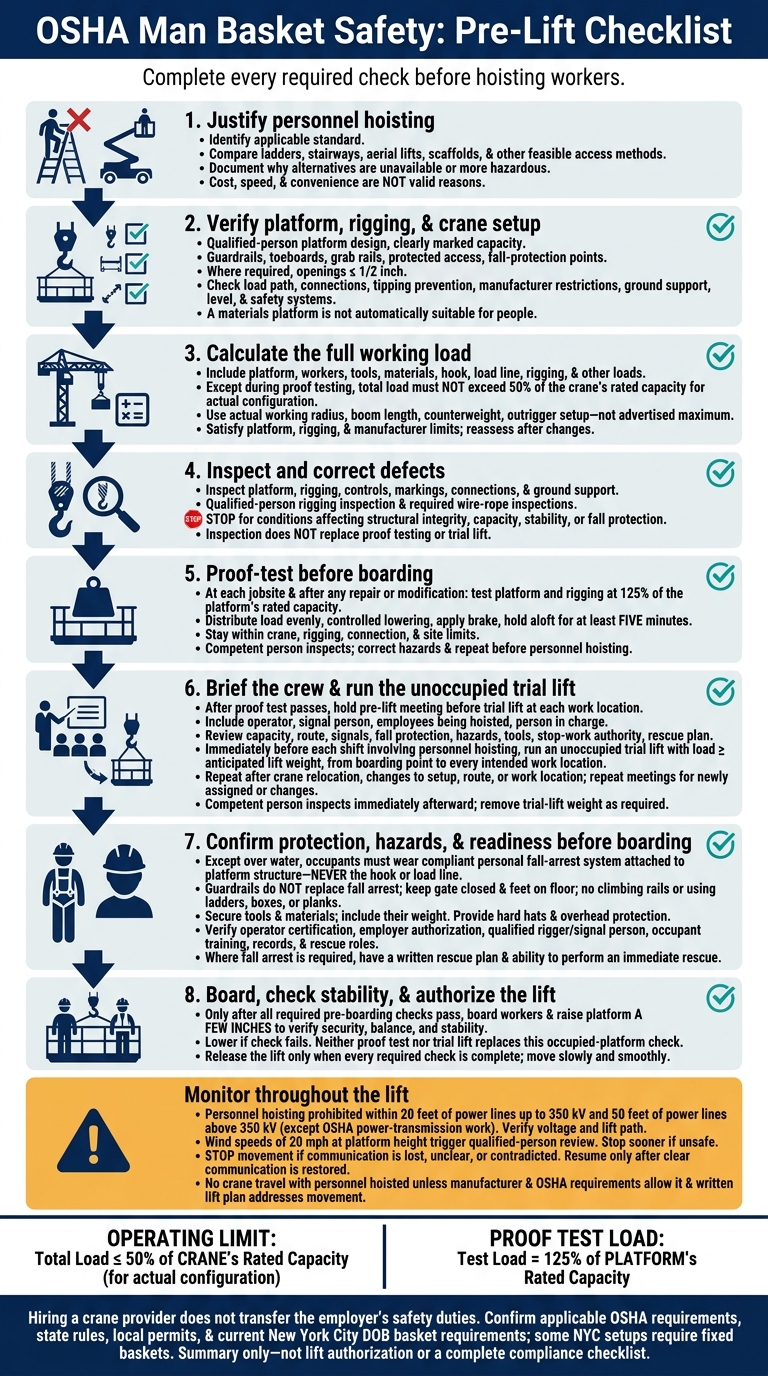
OSHA Man Basket Safety: Pre-Lift Checklist
Confirm When Personnel Hoisting Is Allowed
Assess Access Methods and Site Conditions
After identifying the applicable standard, confirm that personnel hoisting is allowed. Cost, speed, and convenience are not valid reasons for the lift. Compare ladders, stairways, aerial lifts, scaffolds, and other access methods against the task and site conditions.
For each feasible alternative, document why it is unavailable or more hazardous because of structural design or worksite conditions. Address ground conditions, overhead obstructions, electrical hazards, weather, communication, and rescue access. Put the basis for the lift in writing. OSHA permits personnel hoisting only under the conditions in §1926.1431.
If personnel hoisting is still justified, check that the platform and rigging meet OSHA’s design requirements.
Check Platform Design and Rigging
Verify that a qualified person designed the platform for personnel use and its rated load. Check for a clearly marked capacity, guardrails, toeboards, interior grab rails, and an access gate or equivalent opening protection. Where required, openings must not exceed 1/2 inch. Confirm that structural attachment points are provided for required personal fall-protection systems.
Review the suspension arrangement, occupant limits, inspection criteria, and use restrictions. A platform built for materials is not automatically suitable for people.
Check the entire load path: the crane’s load line and hook, slings, shackles, master links, and platform connections. Suspended platforms must be arranged to minimize tipping. Connections must be secured against unintended opening or disengagement, and personnel-hoisting rigging should be dedicated to that use where required. Even if another company supplies the equipment, the employer remains responsible for verifying design, compatibility, and inspections.
The design and rigging must match the crane’s rated capacity at the working radius. Then verify that the crane and platform can carry the full working load in the actual setup.
Calculate Load Capacity at the Working Radius
Calculate the combined weight of the platform, workers, tools, materials, hook, load line, rigging, and any other imposed loads. Except during proof testing, the total load must not exceed 50% of the crane’s rated capacity for the configuration. Use the actual working radius, boom length, counterweight, and outrigger or track setup - not the crane’s advertised maximum.
Also check the platform’s rated capacity, rigging ratings, crane manufacturer personnel-hoisting restrictions, and platform manufacturer instructions. Verify ground support, level, and setup requirements.
Before hoisting personnel, required safety devices and systems must work. These include applicable anti-two-block protection, controls, brakes, and communication systems. A capacity calculation alone does not authorize the lift. Reassess the plan whenever the radius, setup, location, or platform configuration changes.
sbb-itb-798c36f
Inspect, Proof Test, and Trial Lift
Inspect Equipment and Correct Defects
Before use, confirm that the assembled platform still matches the approved design. Inspect the platform, rigging, controls, and ground support. Make sure identification and rated-capacity markings are readable and all connections are secure. Look for cracks, damaged welds, missing fasteners, rope damage, loose attachment points, and ground settlement.
Have a qualified person inspect the rigging before use, and follow the required wire-rope inspection schedule. Stop work if any condition could affect structural integrity, capacity, stability, or fall protection. Keep unapproved modifications or capacity-affecting repairs out of service until an appropriately qualified person evaluates them.
Inspection does not replace proof testing or a trial lift.
Proof Test the Platform and Rigging
Once the setup passes inspection, proof-test the assembled system before anyone boards. At each jobsite and after any repair or modification, test the platform and rigging at 125% of the platform’s rated capacity.
Spread the test load evenly. Lower the platform using controlled lowering, apply the brake, and hold it aloft for at least five minutes. Stay within the crane, rigging, connection, and site limits.
A competent person must then inspect the platform and rigging and determine that the test passed. If a hazardous condition appears, correct it, repeat the test, and obtain a new passing determination before hoisting workers. Record the test load, duration, equipment ID, findings, and any retest.
Run Trial Lifts and Hold the Pre-Lift Meeting
After the proof test passes, check the actual lift path with an unoccupied trial lift.
Before the trial lift, hold a pre-lift meeting at each work location. Include the crane operator, the signal person if one is used, the employees who will be hoisted, and the person in charge of the lift. Review the lift plan, capacity, route, signals, fall protection, weather and power-line hazards, tool security, stop-work authority, and rescue plan. Repeat the meeting for newly assigned employees and whenever site conditions or procedures materially change.
Immediately before each shift involving personnel hoisting, run an unoccupied trial lift with a load at least equal to the anticipated lift weight. Start at the boarding point and travel to every location where the platform will be hoisted and positioned. This checks the route, landing points, and setup at the actual work location. Repeat the trial lift after relocating the crane or changing the setup, route, or work location. Combine the proof test and trial lift only if both steps are fully completed.
Immediately after the trial lift, a competent person must inspect the equipment, ground support, and platform for defects, damage, instability, or other adverse effects revealed by the lift. Remove the trial-lift weight as required before personnel enter. Do not proceed if the trial lift reveals a defect or unsafe condition.
After workers board, lift the platform a few inches and check that it is secure, balanced, and stable. Lower it if this check fails. Neither the proof test nor the trial lift replaces the occupied-platform check.
OSHA 1926.1431 – Hoisting Personnel (Subpart CC)
Control Hazards and Prepare for Emergencies
Once the platform passes inspection, proof testing, and the trial lift, control the hazards that remain during the actual hoist.
Prevent Falls and Falling-Object Injuries
Guardrails do not replace required fall arrest. Except when working over water, occupants must wear a compliant personal fall-arrest system. Attach it to a structural member in the platform - never to the hook or load line. Keep the gate closed and both feet on the platform floor. Do not sit on, climb over, or lean on the rails. Never use ladders, boxes, or planks for extra height.
Secure tools and materials so they cannot shift, and include their weight when checking platform capacity. Require hard hats and overhead protection wherever falling-object hazards exist.
Before moving the platform, check power-line clearance, weather, and lift communication.
Manage Power Lines, Weather, and Lift Communication
Personnel hoisting is prohibited within 20 feet of power lines up to 350 kV and 50 feet of power lines above 350 kV, except for work covered by OSHA’s power-transmission and distribution provisions. Confirm the voltage and account for the crane, platform, load line, and entire lift path. Wind speeds of 20 mph at platform height trigger a qualified-person review. Stop sooner if conditions are unsafe.
Occupants must stay in direct communication with the signal person or crane operator. Stop movement if communication is lost, unclear, or contradicted. Resume only when clear communication is restored.
Move the platform slowly and smoothly within the planned operating area. Prohibit crane travel with personnel hoisted unless the equipment manufacturer and applicable OSHA requirements specifically allow it and the written lift plan addresses that movement.
Before anyone boards, confirm training, rescue roles, and required records.
Check Training, Rescue Plans, and Required Records
Verify operator certification and employer authorization, along with separate rigger or signal-person qualifications.
Train occupants on safe access, capacity, fall protection, electrical hazards, communication, prohibited actions, weather limits, and emergency procedures.
Before boarding, assign recovery roles for equipment failure, power loss, illness, severe weather, communication failure, and a fall-arrest event. Where fall arrest is required, have a written rescue plan and the ability to perform an immediate rescue.
Keep required operator-evaluation, signal-person qualification, and applicable inspection records available. Also keep written rescue procedures, weather decisions, test results, repair histories, and corrective actions.
Conclusion: Confirm Compliance Before Hoisting Workers
Once training, records, and rescue plans are in place, release the lift only when all checks are complete: crane-hoisted access is justified, the system is suitable, inspections and proof tests are finished, and the trial lift and pre-lift meeting have taken place. Hazard controls, worker qualifications, and rescue arrangements must also be ready.
Hiring a crane provider does not replace the employer’s compliance duties. Address missing checks and clarify responsibilities before work starts.
Coordinate Equipment and Site Needs With L&M Crane
If the job passes the go/no-go check, work with L&M Crane to finalize site logistics. L&M Crane provides crane, rigging, and man-basket services across Long Island, the five boroughs, the greater New York area, and New Jersey.
For HVAC, cell-site, and construction work, confirm equipment compatibility, site access, ground support, crew roles, OSHA requirements, and local permits before mobilization.
In New York City, some setups require fixed baskets. Verify current DOB requirements before mobilization.
FAQs
How do I document why a man basket is necessary?
Keep organized records that justify the use of a man basket and show compliance with OSHA and local requirements. Include load-test reports for the basket and rigging; current certifications for the operator, rigger, and signal person; site-specific safety and emergency procedures; maintenance logs; and inspection certificates.
Store everything in one accessible location so it’s ready for inspection. L&M Crane can help with the required permits and documentation.
Who can verify that my man basket meets OSHA standards?
Qualified personnel should complete and document all required inspections and testing before use. Keep up-to-date certifications and test records for fixed or hanging baskets available for review. Confirm that operators, rigging personnel, and signal personnel hold the credentials OSHA requires.
L&M Crane states that its man baskets are fully inspected and certified to meet OSHA standards. The company also says it maintains inspection logs and compliance records.
How do I check NYC’s fixed-basket requirements?
Use a fixed man basket for suspended personnel work, and verify that its testing and certification records are current. NYC DOB rules prohibit hanging or suspended personnel platforms.
Keep all required documentation complete and on-site, including basket testing and certification paperwork, crane and rigging inspection reports, operator qualifications, and DOB-required permit materials.
Confirm that operators hold current OSHA credentials related to 29 CFR 1926.1431, along with applicable NYC/NYS/NJ licenses or credentials.
Related Blog Posts
Related Articles
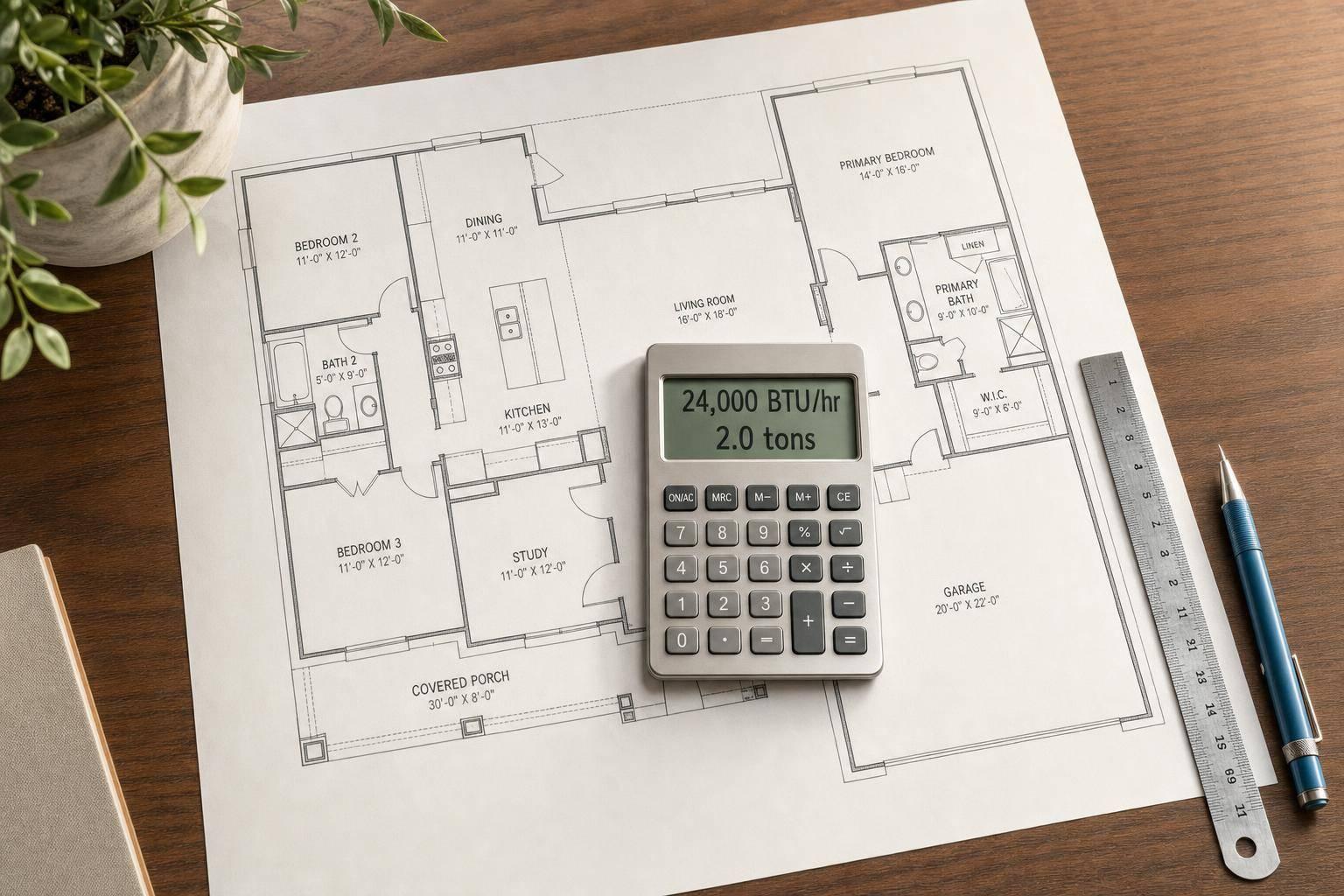
HVAC Tonnage Calculator
Estimate AC size in BTU/hr and tons using area, climate, insulation, and more—then compare your result with practical unit size ranges.
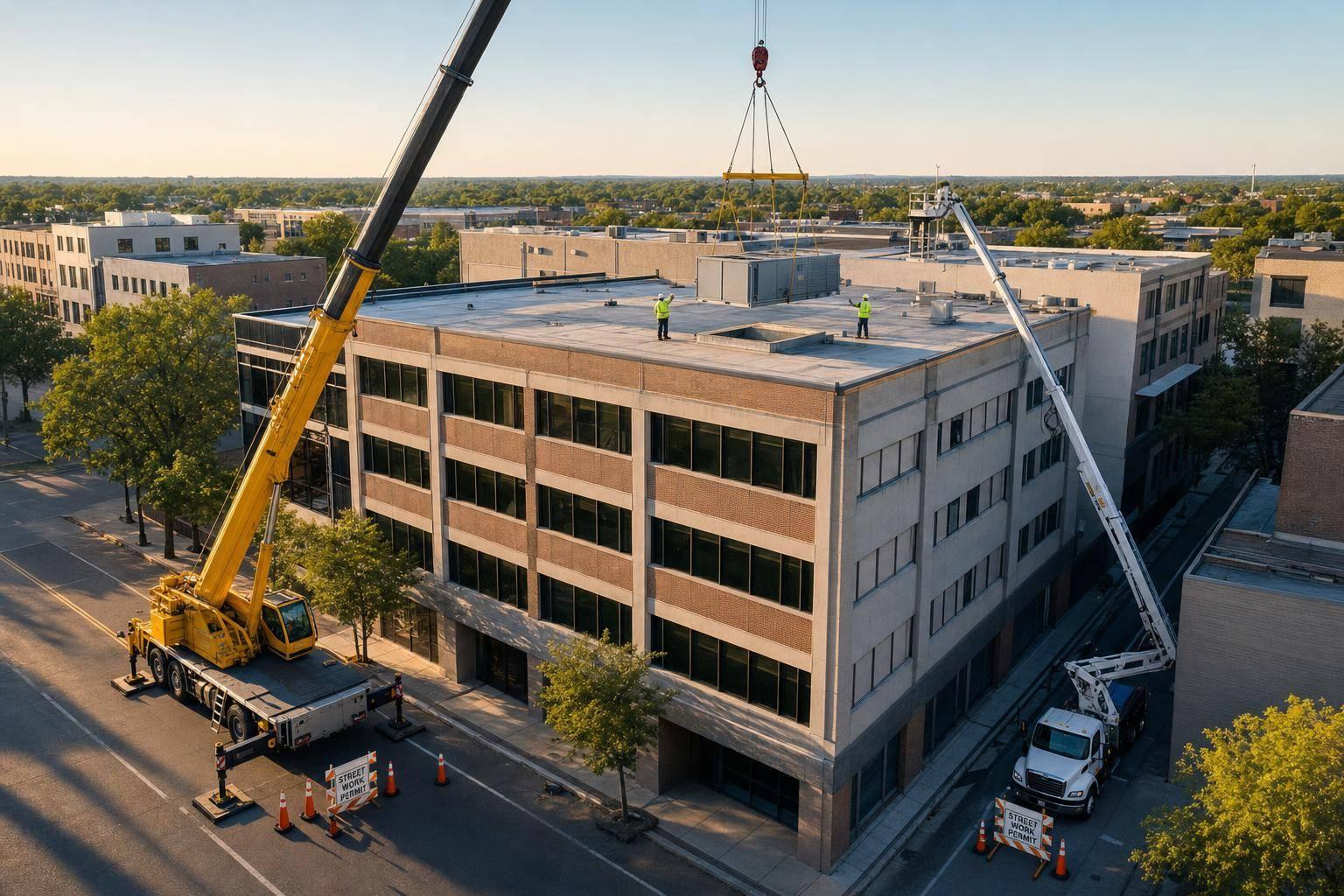
Crane vs Boom Truck for HVAC Lifting
Compare boom trucks vs mobile cranes for rooftop HVAC lifts—weight, height, working radius, site access, permits, and true job cost.
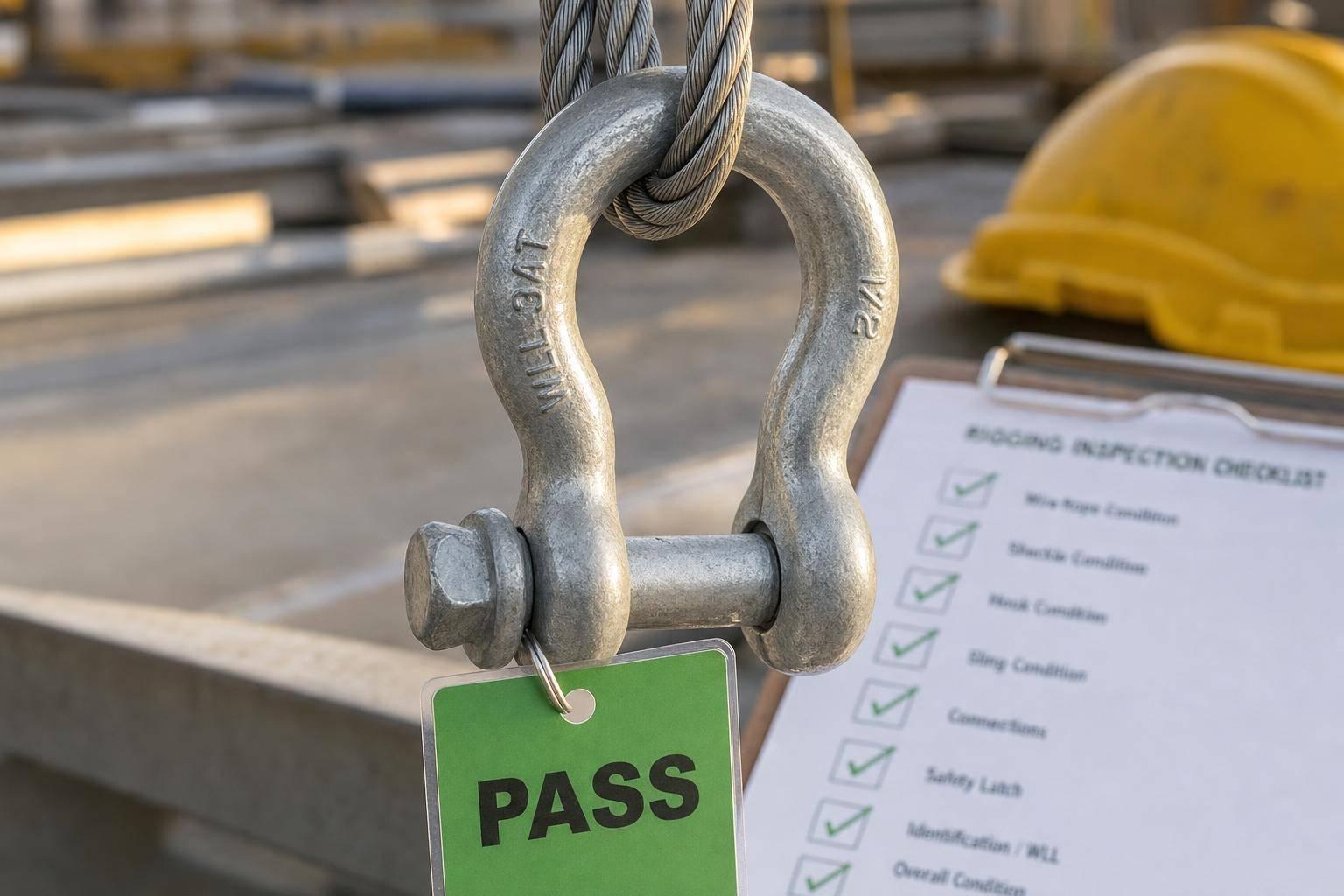
Rigging Inspection Checklist
Run a fast pre-use rigging inspection, flag unsafe conditions, and get a clear pass or Do Not Use result for the jobsite.